
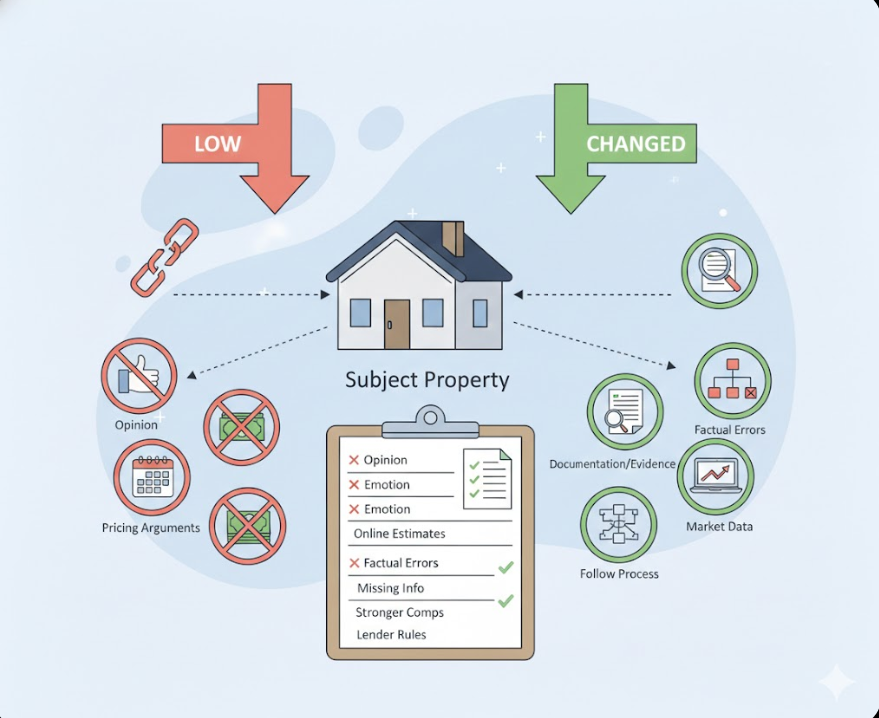
When an appraisal comes in low, most people ask one simple question:
Can a low appraisal be changed?
The answer is yes, sometimes.
But not always.
And not in the way most people think.
Understanding when a low appraisal can be changed, and when it cannot, helps you avoid false hope, wasted time, and bad decisions.

Why Low Appraisals Feel Final
Many homeowners and buyers are told:
- The appraisal is final
- The lender cannot change it
- There is nothing you can do
This creates panic and frustration.
The truth is more nuanced. A low appraisal is not automatically permanent, but it is not easy to change either.

Can a Low Appraisal Be Changed?
A low appraisal can be changed when there are:
- Factual errors
- Missing information
- Weak or inappropriate comparable sales
- Mistakes that affect value
A low appraisal usually cannot be changed when:
- The value reflects market conditions
- There are no clear errors
- The disagreement is based on opinion
- Better sales were not available at the time
The difference matters.

How Low Appraisals Are Reviewed
Appraisals are reviewed through lender-controlled processes, not arguments.
Most lenders allow a formal review when:
- Specific issues are identified
- Evidence supports the issues
- The request follows lender rules
This is often done through a Reconsideration of Value request.
A review does not guarantee a higher value. It guarantees a second look.

What Types of Issues Can Lead to a Change
Low appraisals are most likely to be changed when:
- Square footage is incorrect
- Finished areas were missed
- Upgrades were ignored
- Comparable sales are weak or outdated
- Better comparable sales were available
- Property details are wrong
These are factual problems, not pricing arguments.

What Does Not Change an Appraisal
Many things people try do not work.
Low appraisals are rarely changed by:
- Saying the value is unfair
- Showing online estimates
- Referencing tax assessments
- Using emotional arguments
- Pressuring the lender
- Complaining without evidence
These approaches often make the process harder.
How Often Do Low Appraisals Get Changed?
Appraisals are not revised often, but they are revised sometimes.
Changes are more likely when:
- The issues are clear
- The evidence is strong
- The request is organized
- The process is followed
Changes are less likely when requests are rushed, emotional, or disorganized.
Why Most People Fail to Change a Low Appraisal
Most people fail because:
- They do not know what qualifies as an error
- They submit opinions instead of facts
- They send too much information
- They do not follow lender procedures
- They guess instead of using a system
Even valid issues can be ignored when handled poorly.
Should You Try to Change a Low Appraisal?
It depends.
Trying to change a low appraisal makes sense when:
- The value is clearly affected by mistakes
- You have evidence to support corrections
- Timing allows for review
It may not make sense when:
- The value reflects recent market sales
- Deadlines are tight
- There are no clear errors
Knowing the difference saves time and stress.
What to Do Before Accepting a Low Appraisal
Before assuming the value is final:
- Request the full appraisal report
- Review it line by line
- Look for factual problems
- Understand lender review options
Many people accept a low appraisal without realizing it contained fixable issues.
A Smarter Way to Approach a Low Appraisal
Changing a low appraisal is not about fighting.
It is about:
- Accuracy
- Documentation
- Structure
- Process
When those pieces are missing, the answer is almost always no.
Want to Know If Your Appraisal Can Be Changed?
If you want to know:
- Whether your low appraisal can realistically be changed
- What errors actually matter
- What evidence works
- How to submit a review the right way
- What to do if the value stays the same
The How to Fight a Low Appraisal AppraisalKey Toolkit walks you through the decision process step by step.
Instead of guessing, you get clarity.
Yes, a low appraisal can sometimes be changed.
But success depends on facts, evidence, and process, not frustration.
Knowing whether a low appraisal can be changed helps you make smarter decisions and protect your property’s true value.